


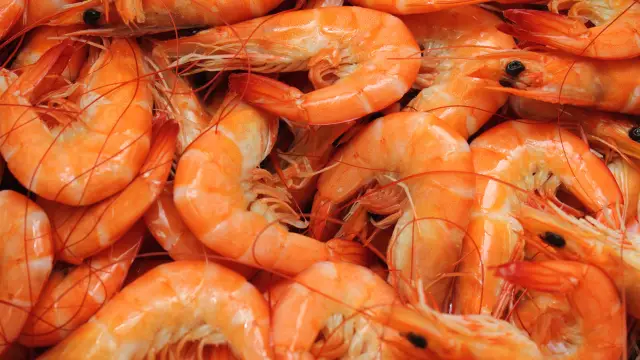
Odisha’s vital shrimp export sector is reeling under the weight of sharply increased reciprocal tariffs imposed by the United States. Industry forecasts suggest that shipments to the traditionally dominant American market have sharply fallen by as much as 75% year-on-year in the first full month following the new levy.
The crisis, which threatens thousands of livelihoods across the coastal state, was formally acknowledged in the State Assembly yesterday by Fisheries and Animal Resources Development Minister Gokulananda Mallick, who confirmed the US tariff hike has severely “disrupted” the flow of Odisha’s marine products.
The Anatomy of the Tariff: India’s Near-60% Burden
The massive disruption stems from a steep reciprocal tariff structure implemented by the US, which has made Indian shrimp one of the most heavily taxed seafood commodities entering the American market.
The total effective duty rate on Indian shrimp now stands between approximately 58% and 60%. This heavy burden is a combination of the recently imposed 50% reciprocal tariff, stacked atop existing levies: a 5.77% Countervailing Duty (CVD), which counters alleged Indian subsidies, and an Anti-Dumping Duty (AD) that typically ranges from 2.49% to 3.96% depending on the exporter. This cumulative rate is drastically higher than the 18% or less previously paid. It critically undercuts India’s market position when compared to key competitors; for instance, Ecuador faces a total tariff burden of around 18.78%, and Indonesia sits at approximately 22.90%.
Quantitative Impact: Volumes Crash, Margins Squeezed
India exported approximately $5 billion worth of frozen shrimp in the last fiscal year (FY25), with the US accounting for nearly 48% of these sales, making it the anchor market. The immediate effect of the tariff spike on these volumes has been acute:
- Monthly Plunge: US imports of Indian shrimp dropped by 43% in August 2025 compared to the previous year, according to trade data. This decline is projected to have steepened further, with industry projections indicating a 75% year-on-year collapse in September shipments as the full 50% tariff took effect on August 27.
- Farm-Gate Price Crash: The uncertainty has led to an internal crisis for farmers. Farm-gate prices for the dominant Vannamei shrimp plummeted from roughly ₹300 per kg to just ₹230 per kg. With production costs estimated at ₹275 per kg, this price drop is causing mounting losses for producers.
- Financial Outlook: Rating agency Crisil anticipates that India’s overall shrimp export volume will decline by 15-18% in the current fiscal year (FY26), predicting that the sector’s operating margins will plunge to a decadal low of 5.0-5.5%.
Mitigation Strategy: ₹25,060 Cr Mission and Market Diversification
In response to the trade headwind, the state and central governments have fast-tracked diversification and financial support measures.
The Union Cabinet has approved the Export Promotion Mission with a total outlay of ₹25,060 crore from 2025 to 2031, aimed at boosting India’s global trade competitiveness. This includes schemes like ‘Niryat Protsahan’ for enhancing trade finance access and ‘Niryat Disha’ for non-financial support.
Minister Mallick highlighted Odisha’s specific efforts, noting the state is actively pursuing alternative markets, including Japan, South Korea, the UK, Russia, Australia, and Southeast Asia. Furthermore, the state government is establishing a dedicated shrimp export cell and a ‘Jalakrishi’ sub-scheme to provide financial assistance for the expansion and modernization of local processing entrepreneurs.
Initial data suggests this diversification strategy is providing a crucial cushion, with export value to non-US markets surging by 30% in the first five months of FY26, indicating Indian exporters are quickly pivoting to offset the devastating loss of American demand.