


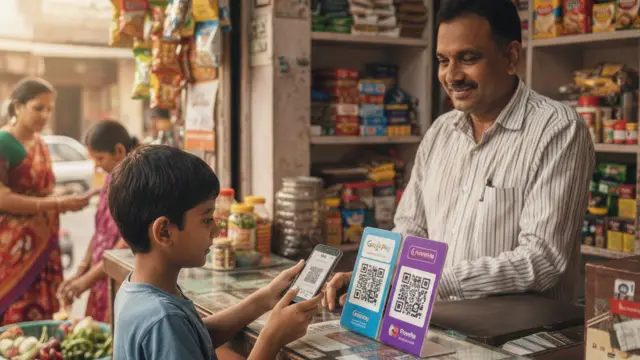
The announcement that the Unified Payments Interface (UPI) crossed 19 billion transactions worth over ₹24.58 lakh crore in November 2025 is not just a growth statistic; it is a financial validation of a revolutionary, public-private business model. The engine behind this phenomenal surge—the National Payments Corporation of India (NPCI)—operates not as a profit-hungry corporation, but as a hyper-efficient, state-backed utility that has strategically unleashed the power of global Big Tech to achieve unprecedented market penetration.
The NPCI’s Frugal Model: A Global Benchmark for Efficiency
The foundational secret to UPI’s spread is the unique cost structure managed by the NPCI. While the NPCI is a non-profit company under Section 8 of the Companies Act, it has achieved what many global financial behemoths cannot: massive scale with minimal operational expenditure.
Industry analysis of the NPCI’s financials for FY 2024-25 reveals a stunning picture of operational frugality:
- Low-Cost Backbone: The estimated cost to run the switch layer for the entire national payments infrastructure is reportedly only around ₹500 crore. This translates to a cost per transaction of approximately ₹0.023 (or less than 3 paise), a figure that is a fraction of the operating costs incurred by major global real-time payment systems.
- The Profit Paradox: Despite the zero-MDR policy on the majority of retail UPI transactions, NPCI remains profitable, generating a significant net profit margin (estimated over 40% in FY25) primarily through fees on other proprietary services like RuPay, IMPS, and FASTag.
This model of frugal infrastructure ensures that UPI transactions can remain essentially free for the end-user, eliminating the cost barrier that slows digital adoption in many Western markets. This policy of “free flow” is the single biggest reason for UPI’s outspread, allowing it to act as the ultimate democratizing force in India’s digital economy.
The Trojan Horse Strategy: Leveraging Big Tech for Penetration
The NPCI successfully built the open rail, but it was the competitive war waged by Third-Party Application Providers (TPAPs) that ensured the carriages reached every corner of the country. This is the ingenious aspect of the UPI business model: it used the deep pockets and aggressive marketing of global and domestic Big Tech to drive mass adoption.
- Customer Acquisition Engine: Apps like PhonePe (Walmart-backed) and Google Pay, which collectively control over 80% of the market volume, initially invested billions in incentives, cashbacks, and advertising. Players like Paytm had also spent massive amounts on market and habit building via freebies and aggressive campaigns during UPI’s formative years. For them, UPI is a customer acquisition tool, not a direct revenue source. They gain users at an unprecedented rate, then cross-sell profitable, high-margin financial services like lending, insurance, and mutual funds.
- Viral Penetration: The open API architecture allowed these TPAPs to create highly engaging, user-friendly interfaces, accelerating penetration into Tier-2, Tier-3, and rural markets that banks traditionally struggled to reach. The ubiquitous presence of the QR code, driven by the TPAPs’ merchant acquisition drive, became the final mile solution for small vendors and kirana stores.
This symbiotic, though sometimes tense, relationship has achieved a market density and a behavioural shift from cash that would have been impossible for a public entity to achieve alone.
The Regulatory Oversight: Managing Concentration Risk
While the collaboration with Big Tech has powered the numbers (volumes soared 32% year-on-year in November 2025), it has created a concentration risk. The dominance of two major TPAPs poses a systemic threat, prompting regulatory intervention.
The NPCI has attempted to enforce a 30% transaction volume market cap on all TPAPs. This move is designed to:
- Maintain Competition: By limiting the growth of the largest players, NPCI encourages diversification, fostering smaller, indigenous fintechs, and promoting competition.
- Ensure Systemic Resilience: Reducing over-reliance on a duopoly minimizes the risk of a single technical glitch bringing down a significant portion of the national payment system.
This regulatory framework underscores NPCI’s primary mandate: to operate a public utility that benefits the entire ecosystem, ensuring both stability and continued innovation, even if it means clipping the wings of its most successful partners. The UPI story, therefore, is not just about technology; it’s a masterclass in public policy, demonstrating how a government-led platform, built on cost-efficiency and open architecture, can leverage private-sector ambition to create a world-leading digital payment revolution.