

Telecom Market Consolidation: Jio, Airtel Command 81% Share in Odisha; BSNL Mounts Strategic 4G Challenge

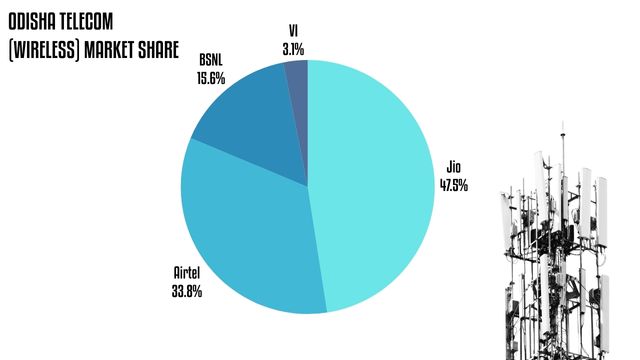
The wireless telecom market in Odisha has consolidated into a formidable near-duopoly, with Reliance Jio and Bharti Airtel collectively securing over 81% of the total subscriber base, according to data presented in the state assembly.
The figures underscore the dominance of private enterprise in the high-growth digital landscape, even as state-run Bharat Sanchar Nigam Limited (BSNL) retains a significant base, leveraging its position for a strategic, government-backed technological counter-offensive aimed at rural connectivity.
The Market Structure: A Tight Duopoly
According to the data shared by Electronics & Information Technology Minister Mukesh Mahaling in a written reply to the state assembly, Reliance Jio leads the market with a commanding 47.54% share. Bharti Airtel is a strong second, holding 33.77%.
This combined market control by the two private giants sets a clear precedent for market power, which could influence future tariff rationalization and investment priorities in the region.
| Operator | Wireless Market Share in Odisha | Primary Market Positioning |
| Reliance Jio | 47.54% | Market leader, driving 5G coverage and volume. |
| Bharti Airtel | 33.77% | Premium segment focus, higher Average Revenue Per User (ARPU) play. |
| BSNL | 15.58% | State-mandated connectivity, rural and remote focus. |
| Vodafone Idea (Vi) | 3.11% | Functionally marginalized, requires significant capital infusion. |
BSNL’s Strategic Indigenous Push
The surprising element is BSNL’s resilient market share of 15.58%, which highlights the stable, non-commercial base it retains, particularly in remote and underserved geographies.
Recent market intelligence provides crucial context for this figure: BSNL has strategically initiated its national indigenous ‘Swadeshi’ 4G rollout from Odisha, with the launch of its ₹37,000 crore, 5G-ready network. The project, heavily funded by the Centre, includes the commissioning of over 2,400 new sites in the state, often using solar power to ensure connectivity in challenging terrain.
Insight: BSNL’s move is less about direct competition with the private duopoly and more about fulfilling a strategic national mandate under the Aatmanirbhar Bharat vision, leveraging its existing captive base to bridge the digital divide in areas where private return-on-investment is low. This state-backed capital injection aims to sustain BSNL as a long-term third-player option.
Vi’s Marginalization and Policy Stance
The data presents a bleak picture for Vodafone Idea (Vi), which holds a negligible 3.10% market share. This figure is critical, as the operator is currently struggling with capital requirements necessary to compete with the aggressive 5G rollouts by Jio and Airtel. Vi’s vulnerability in key regional markets like Odisha underscores the challenges the government faces in maintaining a competitive tri-polar market structure nationally.
Adding to the consolidation narrative, Minister Mahaling confirmed that the Odisha government currently has no plans to introduce an alternative service option for subscribers, similar to the initiative recently undertaken by the Kerala government. This policy stance effectively entrusts the state’s digital future wholly to the private sector and BSNL’s strategic mission.
The future competitive dynamic is therefore set to be determined by the Jio-Airtel battle for premium, high-value subscribers and data monetisation, while BSNL operates on a government-mandated track of service obligation in previously unconnected regions.